The latest playbook in the oil patch has been to pay down debt and then return capital to shareholders. Ensign is now halfway through its three-year goal of paying down $600 million of debt, or roughly $200 million per year. A key question becomes, what will the company do once the $600 million is paid? If we assume the current market cap of $450 million, and sustainability of $200 million in annual free cash flow, Ensign will have considerable optionality. Theoretically, at today’s share price, a return of $100 million in capital to shareholders via a dividend would result in a dividend yield of 22 per cent. The other $100 million could be used for buybacks to reduce the share count by 22 per cent. As Ensign approaches the final stages of its $600 million debt paydown, we suspect the market will start to price in this significant potential optionality by next year.
Money is a medium of exchange that allows people to trade without needing what the other wants. In other words, money acts as an intermediary. Instead of making a direct trade, an indirect trade can be made instead.
For instance, Mr B wants to buy a chicken from Mr A. However, Mr A wants a fish in exchange for their chicken. Mr B does not have the fish that Mr A wants, so an exchange cannot be made. Instead, Mr B gives Mr A $10 for the chicken. Mr A can then use that money to buy the fish from somewhere else. That way, the trade is able to take place.
There are many types of money, and they can come in many forms. So long as people trust and accept it – it can be used as a medium of exchange.
For example, gold was historically used as a form of monies. Farmers would go to the market and sell their cows in exchange for a certain amount of gold. The farmer could then exchange his gold for a loaf of bread from the baker. The farmer wouldn’t exchange his cow for gold if he knew the baker wouldn’t accept it in exchange for some bread.
Types of Money
On its own, money is essentially worthless – except for commodity money. It is the trust that people place in it that gives it value. For certain types of money, such as commodities (gold/silver), there is an element of stored value. By contrast, other types such as fiat money are only backed by the government and people’s faith in it.
The third type of money is not what we would traditionally call ‘money’, but rather debt. This is known as commercial bank money and is backed by governments and central banks. Its trust first comes from depositors who store their money, then, from the commercial banks that lend money. Both depositors and commercial banks trust that they will get their money back and that it will still have value when they do.
Let us now look into these three types of money below:
1. Commodity Money
Origins of Commodity Money
Commodity money has been around for millennia. Its origins are almost impossible to determine, but records suggest that commodities such as gold became a common form of money during the period 700-500BC.
The origins of commodity money link back to the Lydian merchants, who produced a gold coin mixed with silver – otherwise known as ‘electrum’. This became a standardized unit of value to help traders convert money and trade between countries. The electrum coin later achieved royal ascent in 550 B.C., as it went into full circulation under the order of King Croesus of Lydia.
Types of Commodity Money
In the preceding centuries, salt, gold, silver, tobacco, and even seashells, were all used as forms of money. Gold became the most favoured because it met three functions of money: a medium of exchange, store of value, and limited availability.
Salt, tobacco, and seashells were commonly used. However, they often went through periods of rapid and excess supply – which meant inflation would result. By contrast, gold was rare enough to prevent a huge influx in the supply of money that would cause inflation. And even though the gold rush of the 19th Century increased the gold supply significantly, it was nowhere near as destructive as the increases in the supply of other commodities, such as salt or tobacco.
What is Commodity Money
Unlike other forms of money, commodity money has a store of value. Even if nations no longer use a commodity as a form of money, it still has value. It is physical. We can see it and touch it. However, other forms of money cannot be seen or touched and are solely built upon the trust of its value.
A commodity is a real thing, so to speak. The underlying value of commodity money is what builds people’s trust in it. Gold, silver, and tobacco all have uses outside of its use as a medium of exchange. So even if it was to be rejected by one store, it will have significant value elsewhere. This contrasts sharply with fiat money, where its value is built upon by the nation’s trust in government.
In economic terms, commodity money has ‘intrinsic value’. In other words, it has a value other than its use as money. For instance, gold can be used as a medium of exchange, but it can also be used for jewellery, gilding, or, an insulator. So, quite simply, it has other uses.
Why Commodity Money
Commodity money was used because it provided a good store of value. It was something everyone could trust.
As we trust the dollar backed by the government today, people trusted a gold coin stamped with the Royal seal. Even items such as salt or tobacco were trusted, because people knew they were well demanded commodities.
As items such as salt and tobacco were in demand, they could be traded easily. Even if one party did not want a commodity, they knew they would be able to trade it with a third party.
It was because of commodities’ intrinsic value that trust was fostered. And it was with that trust which allowed it to become widely accepted throughout the world.
2. Fiat Money
Origins of Fiat Money
The origins of fiat money come from the Chinese Tang dynasty in the 11th Century. By the 12th Century, fiat money had become widely used throughout the country. It came under various names such as; jiaozi, huizi, and guanzi.
During the 13th century, Marco Polo described the fiat money of the Yuan Dynasty in his book The Travels of Marco Polo:
All these pieces of paper are issued with as much solemnity and authority as if they were of pure gold or silver; and on every piece, a variety of officials, whose duty it is, have to write their names, and to put their seals.
What is Fiat Money
Fiat money only has value by people’s trust in it. This trust is built by governments declaring it as a legal tender – allowing all people and businesses to accept it as a means of payment. Trust is then further secured as governments outlaw all other forms of money.
“Whilst Commodity money has intrinsic value, fiat money does not.”
Unlike Commodity money, fiat money has no intrinsic value. It is backed by the government and created by central banks. And it is because there is no limitation on supply that inflation is more likely under fiat money. Governments and central banks can simply create more of it when needed. Although, with that said, this was also a common occurrence under commodity money, as rulers would simply reduce the level of gold content in the coins it issues.
Whilst there is only so much gold or silver in the world, there is no limit on how much fiat money there is. Two notable examples include the hyperinflation in Venezuela and Zimbabwe. The two respective governments had no checks in place as they continued to create new fiat money.
Types of Fiat Money
Fiat money is widely used today through the modern and even the developing worlds. These usually cover bank notes and coins. Such examples include the Euro, the US dollar and the Great British Pound.
However, fiat money does not cover banknotes that people can exchange for gold or silver. During the period of the golden standard, there were banknotes – but we cannot define these as fiat money. That is because it is essentially backed by a commodity that has an intrinsic value. As people could trade the banknotes for gold, they had some value.
History of Fiat Moneys Rise
The gold standard and other commodity monies were very restrictive. A country is bound by its stock of gold. If a country has low levels of gold reserves, it would be unable to meet its financial commitments. This can cause people to lose trust in the government’s ability to meet its promises.
Back during the gold standard, the US cut official ties in 1933 after the Great Depression. It banned the sale and exchange of gold throughout the country, although it did let foreign countries exchange at a rate of $35 to an ounce of gold. This worked well as the US had high levels of gold reserves and the international exchange rates were kept in line through the Bretton Woods agreement.
The issue lied in the fact that the US adopted fiat money at home, but guaranteed a commodity-backed currency abroad. In other words, the US linked other currencies such as the British pound to the US dollar, which could, in turn, be exchanged for gold. This didn’t work as the Federal Reserve was increasing the supply of the dollar in the US. In turn, greater numbers of US dollars were flowing to other countries as the US traded with other nations.
The money supply of US dollars was increasing, but the exchange rate to an ounce of gold remained at $35. As time wore on, the US was printing more dollars than it could back internationally with its gold reserves. By 1966, the US would have been unable to meet its obligations. Foreign nations had over $14 billion in US dollars, whilst the US treasury only had $13.2 billion in gold reserves.
“Over the years, it became clear that the supply of gold was insufficient to meet the economic output of rapidly growing economies.”
Over the years, it became clear that the supply of gold was insufficient to meet the economic output of rapidly growing economies. There was also a tendency for Central Banks to try and maximising employment, which meant huge amounts of money were injected in order to achieve this aim. This increased the number of dollars in circulation, but not the amount of gold needed to represent the newfound money.
Why Fiat Money
Fiat money is potentially a more stable form of money than commodities. This is because there is a steady supply provided by the central bank or government – whoever is in control.
By contrast, a sudden surge in the quantity of gold, silver, or other commodity would increase the money supply dramatically. Historically, this has caused sharp decreases in its value – meaning inflation has resulted.
Fiat money gives central banks and governments much more control over the money supply. It can control shocks better, and it is more adaptable to stimulating the economy. The main issue, however, is the inability to limit how much governments can print.
As governments are in the business of winning votes, it is very easy for politicians to offer free stuff. Governments then pay for that free stuff through newly printed money. However, this causes the type of hyperinflation we have seen in Venezuela, Zimbabwe, or the Weimar Republic in Germany.
The way around this was to have independent Central Banks that are self-funded and have a set mandate. That mandate today is generally to hold inflation down to around 2 percent, whilst also ensuring economic stability. To varying extents, Central Banks have largely achieved their aims, but only thanks to the ability to create fiat money from thin air.
3. Commercial Bank Money
Commercial Bank Money is essentially debt that is created through the fractional reserve system. For every $100 received in deposits, banks may only keep $10 behind to satisfy depositors’ short-term withdrawals, whilst lending out the other $90.
This creates what is commonly referred to as the ‘money multiplier’ effect. It is calculated by dividing 1 by r (1/r), where r equals the reserve ratio. In this case, the ratio would be 10%, which once divided by 1 equals 10. This multiplier effectively states how much money the original deposit creates; which for this example is $100. The multiplier, therefore, shows that the original $100 multiplies to create $1,000.
To demonstrate how this works, let us look at the existent amount of notes and coins in circulation. In total, the US has just under $1.5 trillion in circulation. How can that work when the GDP of the US is just over $19 trillion? At the same time, the M3 money supply – one of the broadest measures – is $15 trillion. That means $15 trillion is in circulation, despite only $1.5 trillion being the actual currency. The $13.5 trillion that is unaccounted for is commercial bank money – or debt.
We can define this as commercial bank money. Only $1.5 trillion is fiat currency. Banks create the rest as debt, or ‘IOUs’. If everyone claimed their debts all at the same time, there would be massive levels of deflation. This is because commercial bank money would cease to exist.
Origins of Commercial Bank Money
Its origins date back to the medieval period. The Bardi, Peruzzi, and Acciaiuoli companies of Florence were among the first banks to use fractional reserve banking. Dating back to the beginning of the 12th century, they became among the leading lenders in Europe. This system is essentially what banks use today, with them lending out a proportion of what they receive from deposits.
What is Commercial Bank Money
Commercial Bank money is debt that has been created by banks with customers fiat money. It is essentially an ‘IOU’ created by the bank, with the ledger marking some figures in the customers account.
When Customer A goes to Bank A, they put $100 in their checking account. That bank keeps $10 aside. This is what is called the ‘reserve ratio’. It then lends $90 out to another customer, Customer B. They then buy something from Customer C for $90. Customer C then puts the $90 into Bank A.
So Bank A has the original $100 that it started with. However, there is a catch. Bank A owes Customer A $100, but also Customer C $90. If both customers come to collect their money, Bank A will be unable to meet its obligations. It is therefore reliant on Customer B to pay back the $90 they borrowed.
Bank A has total assets of $190. That includes the $100 in physical money deposited by Customer A and subsequently Customer C. Also, the debt provided to Customer B is classified as an asset. At the same time, they have to pay Customer A their $100 and Customer C their $90.
So in total, $190 is going around in circulation, despite there only being $100 in fiat currency. The extra $90 has been created as debt by the bank and represents what we call Commercial Bank Money.
About Paul
Paul Boyce is an economics editor with over 10 years experience in the industry. Currently working as a consultant within the financial services sector, Paul is the CEO and chief editor of BoyceWire. He has written publications for FEE, the Mises Institute, and many others.
Paul Daneshrad is the founder & CEO of StarPoint Properties, a well-respected real estate investment and development firm.
Over the past 30 years, the S&P 500 and the Nasdaq—both productive assets—have surged almost fivefold and eightfold, respectively. In contrast, gold, a nonproductive asset, has only risen 2.5 times in value.
“Gold is a way of going long on fear. And it’s been a pretty good way of going long on fear from time to time,” remarked Warren Buffett in a 2011 interview, highlighting how people often turn to nonproductive assets such as gold for safety during economic downturns, even though these assets do not generate income.
Additionally, Buffett famously noted, “The stock market is designed to transfer money from the active to the patient,” emphasizing the significant potential of patient, long-term investing in productive assets for building substantial wealth over time.
While the returns on any investment are driven by multiple factors such as the performance of the underlying assets, economic conditions, market sentiment, etc., which are beyond our control, we can make informed investment choices.
Productive Assets
A productive asset is an investment that generates income or appreciates in value over time. The key characteristic of productive assets is that they are not merely speculative.
They have inherent value and are expected to generate returns independently of the selling price on the market, either through generating revenue, providing rental income, earning interest or increasing in intrinsic value.
Examples of productive assets include commercial and rental real estate, stocks, business ownership, investing in trade financing, intellectual property and royalty interests.
Nonproductive Assets
A nonproductive asset is one that doesn’t generate income or increase in value through its own productivity.
Instead, its value typically comes from selling it at a higher price than it was purchased at.
The investor buys the asset with the hope of selling it to someone else at a higher price in the future, relying on the belief that there will always be another investor (“a greater fool”) willing to pay more—a concept known as the “greater fool theory.”
Precious metals, collectibles, speculative real estate, cryptocurrencies, luxury goods and unproductive land all fall under the category of nonproductive assets.
Factors Influencing Asset Performance
Productive and nonproductive assets react differently to economic, political and social factors, which often distinguish their financial performance.
For instance, the Nasdaq-100 experienced a significant decline in 2022, ending the year with losses of nearly 33%; however, it made a strong recovery in the first three quarters of 2023, due to the boom in the AI sector.
Here are some other major factors that influence an asset’s performance:
Economic Downturns
Productive assets, such as businesses and income-generating real estate, exhibit greater resilience during economic downturns due to their ability to generate income and preserve value.
In contrast, the value of nonproductive assets is closely tied to consumer sentiment and disposable income.
Time Horizon
Productive assets shine when investors have a longer investment horizon. Over time, the compounding effect of income generation and asset appreciation becomes more pronounced, which can result in substantial wealth accumulation.
In contrast, nonproductive assets may not offer the same long-term growth potential. Their value may remain stagnant or even decrease over extended periods, making them less suitable for long-term wealth-building strategies.
Crisis Or Geopolitical Tensions
In times of uncertainty, nonproductive assets such as precious metals and certain currency-based investments, seen as safe havens, often experience increased demand as investors seek to preserve wealth.
However, such shifts in asset allocation might not offer significant returns or income, besides causing investors to miss out on potential market rebounds when tensions ease.
For example, after Covid-19 began, gold prices reached a then-record high in August 2020, acting as a hedge against uncertainty. But with vaccine rollouts in 2021 reducing uncertainties, gold had its worst start to a year in a decade, showcasing its volatility in response to shifting market sentiment.
Risk Tolerance
In a 2011 letter to Berkshire Hathaway shareholders, Buffett defined investment risk as the potential to erode the owner’s purchasing power over the holding period, (i.e., the same amount of money may not buy as much as it used to) and not merely as the fluctuation in the value of an asset.
By this definition, nonperforming assets are high-risk because they offer no purchasing power during ownership and often come with significant idiosyncratic risks, such as collectibles’ vulnerability to market trends.
In contrast, productive assets typically allow for risk management through diversification and active management.
Inflation
Productive assets can provide a hedge against inflation by offering income that adjusts to counter rising costs, while nonproductive assets may not offer the same protection against the erosion of purchasing power.
Changing interest rates, liquidity and labor dynamics are other factors that affect asset performance.
Why Productive Assets Stand Out?
Besides income generation and resilience to most factors influencing investment value, here are some other compelling reasons that make productive assets stand out:
• Active Management: Productive assets can benefit from strategic decisions such as improvements, innovation or operational changes. This active management can boost yields and increase long-term value, distinguishing them from more nonproductive assets.
• Value Appreciation Potential: The potential for capital appreciation is significant. While nonproductive assets can also appreciate, productive assets often offer both income and appreciation, enhancing total returns over time.
• Tax Benefits: The tax advantages associated with certain productive assets can significantly impact net returns. These benefits can include deductions, credits and more favorable tax treatment on income or gains.
In Closing
Securing your financial future begins with informed choices. To help you make decisions that maximize your asset performance, make sure you’re keeping up with market trends and exploring tax-efficient investment strategies. And when investing in productive assets, building a well-diversified portfolio is key. Lastly, due to the nature of productive assets and their growth potential over longer investment horizons, it’s important to adopt a patient, long-term perspective.
The information provided here is not investment, tax or financial advice. You should consult with a licensed professional for advice concerning your specific situation.
Forbes Finance Council is an invitation-only organization for executives in successful accounting, financial planning and wealth management firms. Do I qualify?
Money in the present is worth more than the same sum of money to be received in the future
What is the Time Value of Money?
The time value of money is a basic financial concept that holds that money in the present is worth more than the same sum of money to be received in the future. This is true because money that you have right now can be invested and earn a return, thus creating a larger amount of money in the future. (Also, with future money, there is the additional risk that the money may never actually be received, for one reason or another). The time value of money is sometimes referred to as the net present value (NPV) of money.
How the Time Value of Money Works
A simple example can be used to show the time value of money. Assume that someone offers to pay you one of two ways for some work you are doing for them: They will either pay you $1,000 now or $1,100 one year from now.
Which pay option should you take? It depends on what kind of investment return you can earn on the money at the present time. Since $1,100 is 110% of $1,000, then if you believe you can make more than a 10% return on the money by investing it over the next year, you should opt to take the $1,000 now.
On the other hand, if you don’t think you could earn more than 9% in the next year by investing the money, then you should take the future payment of $1,100 – as long as you trust the person to pay you then.
Time Value and Purchasing Power
The time value of money is also related to the concepts of inflation and purchasing power. Both factors need to be taken into consideration along with whatever rate of return may be realized by investing the money.
Why is this important? Because inflation constantly erodes the value, and therefore the purchasing power, of money. It is best exemplified by the prices of commodities such as gas or food. If, for example, you were given a certificate for $100 of free gasoline in 1990, you could have bought a lot more gallons of gas than you could have if you were given $100 of free gas a decade later.
Inflation and purchasing power must be factored in when you invest money because to calculate your real return on an investment, you must subtract the rate of inflation from whatever percentage return you earn on your money.
If the rate of inflation is actually higher than the rate of your investment return, then even though your investment shows a nominal positive return, you are actually losing money in terms of purchasing power. For example, if you earn 10% on investments, but the rate of inflation is 15%, you’re actually losing 5% in purchasing power each year (10% – 15% = -5%).
Time Value of Money Formula
The time value of money is an important concept not just for individuals, but also for making business decisions. Companies consider the time value of money in making decisions about investing in new product development, acquiring new business equipment or facilities, and establishing credit terms for the sale of their products or services.
A specific formula can be used for calculating the future value of money so that it can be compared to the present value:
Where:
FV = the future value of money PV = the present value i = the interest rate or other return that can be earned on the money t = the number of years to take into consideration n = the number of compounding periods of interest per year
Using the formula above, let’s look at an example where you have $5,000 and can expect to earn 5% interest on that sum each year for the next two years. Assuming the interest is only compounded annually, the future value of your $5,000 today can be calculated as follows:
FV = $5,000 x (1 + (5% / 1) ^ (1 x 2) = $5,512.50
Present Value of Future Money Formula
The formula can also be used to calculate the present value of money to be received in the future. You simply divide the future value rather than multiplying the present value. This can be helpful in considering two varying present and future amounts.
In our original example, we considered the options of someone paying your $1,000 today versus $1,100 a year from now. If you could earn 5% on investing the money now, and wanted to know what present value would equal the future value of $1,100 – or how much money you would need in hand now in order to have $1,100 a year from now – the formula would be as follows:
PV = $1,100 / (1 + (5% / 1) ^ (1 x 1) = $1,047
The calculation above shows you that, with an available return of 5% annually, you would need to receive $1,047 in the present to equal the future value of $1,100 to be received a year from now.
To make things easy for you, there are a number of online calculators to figure the future value or present value of money.
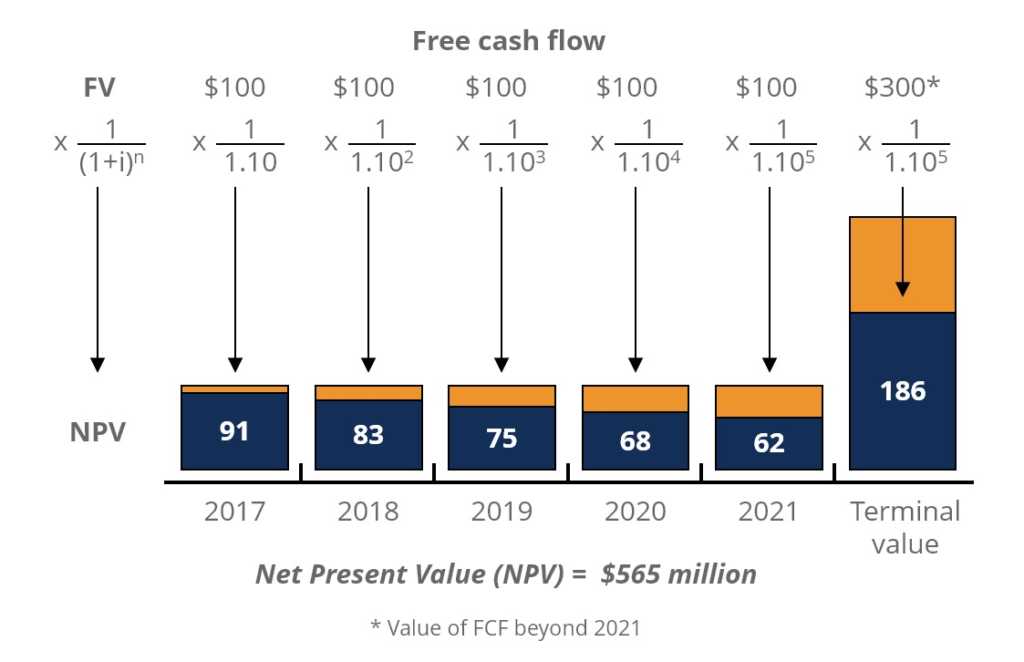
Net Present Value Example
Below is an illustration of what the Net Present Value of a series of cash flows looks like. As you can see, the Future Value of cash flows are listed across the top of the diagram and the Present Value of cash flows are shown in blue bars along the bottom of the diagram.